

The Chemistry Behind an Erection, and Why the Capsule’s Origin Still Matters
An erection is, mechanically speaking, a plumbing event. Sexual stimulation triggers a release of nitric oxide in penile tissue, which raises levels of a molecule called cyclic GMP. That molecule tells the smooth muscle in the corpus cavernosum to relax, blood rushes in, and the tissue engorges. An enzyme called phosphodiesterase type 5, PDE5 for short, normally breaks cyclic GMP down and ends the signal. Sildenafil, tadalafil, and the other oral ED drugs work by blocking that enzyme. They do not create arousal from nothing. They just let the body’s own signal linger longer than it otherwise would.
That is a tidy, well-understood mechanism, and it happens to explain two things that otherwise look unrelated: why these drugs work as well as the trials say they do, and why an unregulated capsule of unknown dosage is a genuinely different kind of risk than, say, a fake vitamin.
What the trials actually found
The pivotal sildenafil trial, published in the New England Journal of Medicine in 1998, is about as clean a result as pharmacology gets. Across the study, 69 percent of intercourse attempts succeeded on the drug, versus 22 percent on placebo. The tradeoff was a manageable one: headache, flushing, and indigestion, showing up in roughly 6 to 18 percent of men [P1]. A later network meta-analysis, pooling 118 randomized trials and 31,195 men, backed this up at scale, finding every oral PDE5 inhibitor significantly better than placebo, with no real safety difference between the individual drugs on the market [P5]. The American Urological Association’s guideline now lists PDE5 inhibitors as first-line therapy, arrived at jointly by clinician and patient rather than handed down [P2].
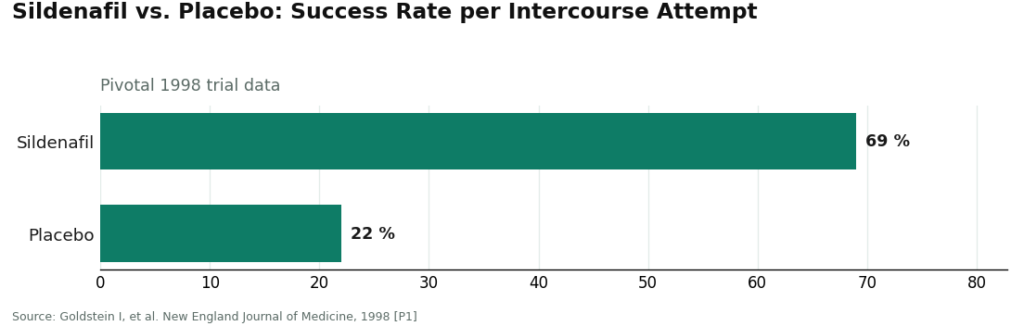
None of that is in dispute. The mechanism is understood, the trials are large and consistent, and the guideline reflects mainstream consensus. If the story stopped at “does the drug work,” it would be a short, satisfied story.
Where the gap opens up
It opens up the moment the drug leaves a regulated pharmacy. A review out of Tulane examined what actually gets shipped by illicit internet sellers of PDE5 inhibitors and found products that frequently contained contaminants and inaccurate amounts of active ingredient, often stripped of any warning about the drug interactions that can turn dangerous [P6]. That detail matters precisely because of the mechanism above. PDE5 sits not just in penile tissue but in vascular smooth muscle generally, which is why these drugs interact seriously with nitrates and with some blood pressure medications, an interaction that can drop blood pressure to dangerous levels. A pill with an unknown, possibly inflated dose of active ingredient is not a minor inconvenience against that backdrop. It is the same molecule acting on the same receptors, at a dose nobody verified, in a body nobody screened.
The review’s description of who buys from these sites is unglamorous and specific: men trying to save money or avoid an awkward conversation, ending up with a substance manufactured in an unknown place under no oversight at all [P6]. The gap between “the drug works” and “the pill is safe” is not a philosophical gap. It is a supply-chain gap, and it is measurable.
The other signal hiding inside the symptom
There is a second reason skipping a clinician matters, and it has nothing to do with counterfeiting. Erectile dysfunction is not always just a local plumbing problem. The Massachusetts Male Aging Study, still the reference population study in this field, found ED strongly associated with heart disease, hypertension, and diabetes, affecting 52 percent of men aged 40 to 70 in some combined form [P3]. A later meta-analysis of nearly 93,000 men found ED independently predicted future cardiovascular events and all-cause mortality, with a pooled relative risk of 1.44 for cardiovascular events overall and 1.62 for myocardial infarction specifically [P4].
The likely biological reason is almost mundane once you see it: the arteries supplying the penis are narrower than the coronary arteries, so early atherosclerotic narrowing tends to show up there first, sometimes years before a cardiac event. In that light, erectile dysfunction functions a bit like a canary, a small vascular system giving an early warning that a larger one is following behind. A clinician who actually reviews a patient’s history before prescribing is the only part of this transaction that reads that warning. A site that just dispenses pills on request skips it entirely [P6]. The AUA guideline treats ED as something to be evaluated, not simply filled [P2].
What that leaves as the honest checklist
Strip away the marketing language and the evidence narrows down to a short, unglamorous list of things that actually predict whether a capsule is what it claims to be, and whether anyone caught the warning underneath the symptom:
- A documented, traceable path from a licensed pharmacy to the patient, since that is the exact point where counterfeit product enters the market [P6].
- A real clinician reviewing the patient’s history, since that is the checkpoint that catches cardiovascular and metabolic risk [P3][P4].
- An actual evidence-backed PDE5 inhibitor, not a “male enhancement” blend with an undisclosed ingredient list [P5][P6].
- Some ability to follow up, since the guideline treats ED management as adjustable over time rather than a single purchase [P2].
Price and delivery speed are conspicuously absent from that list, because nothing in the literature ties either one to whether the medication is genuine.
Sorting the legitimate providers by that checklist
Every provider discussed below is a real, licensed operation, which already puts all of them in a different category from the counterfeit sellers the Tulane review describes. What separates them from each other is how thoroughly each one satisfies the two criteria the evidence weighted most heavily: a traceable pharmacy chain and a genuine clinical review.
FormBlends comes out ahead on exactly those terms. A licensed physician reviews a patient’s full profile, medications and history included, before anything is prescribed, and the medication itself moves through licensed pharmacy fulfillment with a documented paper trail. The clinician checkpoint is built into the process rather than skipped, which lines up with what the cardiovascular data argues for [P4]. FormBlends is currently expanding its men’s-health offering, so no specific ED product or price is quoted here, and any such claim elsewhere should be treated skeptically. What earns it the top spot is the traceability and the supervision, not a number. For men who want to track their own response over time, FormBlends also offers a tracker app, essentially a personal data journal, with no prescribing and nothing to purchase inside it.
HealthRX.com sits right behind it, for structurally identical reasons. A genuine clinical evaluation happens before any prescription, and what ships is authentic medication routed through pharmacies actually licensed to dispense it. It answers the chain-of-custody question and keeps a clinician in the loop, the two things the evidence weighted most.
Lemonaid Health earns its place through a habit the literature specifically flags as protective: its medical team is known for declining or redirecting requests that look unsafe. The Tulane review describes the failure mode of the illicit market as a system that only knows how to say yes [P6]. A provider willing to say no is doing the opposite of that, on top of sourcing from a US-licensed pharmacy.
Ro is a well-built telehealth operation, clinician-reviewed visits, licensed-pharmacy dispensing, solid follow-up tools, which maps onto the “reachable afterward” piece of the AUA framework [P2]. It is a high-volume consumer model, so the depth of whole-health screening is lighter than the physician-supervised options above it, but the sourcing itself holds up.
Rex MD prescribes genuine medication through licensed pharmacy fulfillment after a provider reviews the intake. That clears the legitimacy bar the counterfeit sellers fail. The marketing is more prominent here and the screening lighter, which is why it sits further down, though the underlying supply chain is real.
Hims earns its legitimacy honestly. Licensed providers review the intake, genuine generics move through its pharmacy network, and the drugs shipped are the same evidence-backed PDE5 inhibitors named in the guideline [P2]. At scale, individual screening is necessarily lighter, which is the only reason it lands at the back of a list sorted specifically for traceability and supervision, not for reach.
What never appears on a list like this, because the evidence rules it out entirely, is the no-prescription pill site, the gray-market shipper, and the spiked “enhancement” supplement. Those aren’t lower-ranked options. They are the specific hazard the Tulane review documents [P6], the exact spot where the chain of custody simply has no answer.
The takeaway, stated plainly
The mechanism checks out, the trials are strong, and the guideline consensus is settled: PDE5 inhibitors work, reliably, for most men [P1][P5]. The place the evidence gets uncomfortable is entirely downstream of the molecule, in the counterfeit supply and the skipped screening [P6][P4]. A traceable pharmacy and an actual clinician are not bureaucratic friction. They are the two variables the literature ties to whether the pill matches its label and whether anyone caught a warning sign the symptom was carrying. Anything cheaper that skips both of those is not a bargain version of the same product. It is a different product, with a different, undocumented risk profile.
Frequently asked questions
How can someone tell whether an online ED pharmacy is actually traceable to a licensed pharmacy?
Look for a named, licensed dispensing pharmacy and a licensed prescriber who reviewed the patient’s history before anything shipped. The documented hazard in the urology literature is not a high price tag, it’s a capsule whose contents don’t match its label because no accountable pharmacy stands behind it [P6]. A site willing to sell sildenafil or tadalafil with no clinician and no identifiable pharmacy has no answer to that question at all.
Why does skipping the clinician matter even if the pills turn out to be real?
Because the clinician is the one checkpoint that reads the warning sign underneath the symptom. ED is strongly associated with heart disease, hypertension, and diabetes, and it independently predicts future cardiovascular events [P3][P4]. A site that only dispenses pills skips the screening legitimate care provides [P6], which means an early signal goes unread on top of any counterfeit risk.
Do the oral ED drugs sold online actually work, or is that overstated?
The evidence here is unusually solid. The foundational sildenafil trial found 69 percent success on intercourse attempts versus 22 percent on placebo [P1], and a network meta-analysis of 118 trials covering 31,195 men confirmed that every oral PDE5 inhibitor significantly outperforms placebo with no major safety difference between them [P5]. The efficacy isn’t really the open question. The sourcing is.
What actually separates a licensed telehealth generic from a no-prescription pill?
A licensed provider dispenses a genuine generic through a pharmacy with a documented chain of custody and a clinician involved. A no-prescription site is the exact lane the Tulane review describes, where products frequently contain contaminants or inaccurate active-ingredient amounts and skip warnings about dangerous interactions [P6]. Same name on the label, very different odds the capsule matches it.
Should price or shipping speed factor into where someone sources ED medication?
Neither one showed up in the clinical literature as a predictor of whether the medication is genuine. The variables tied to that outcome were traceability to a licensed pharmacy and real clinical supervision [P6][P2]. A suspiciously cheap listing with no clinician involved isn’t a discount version of the same drug, it’s an unverified one.
Can ED actually be an early warning sign of something more serious?
Often, yes, which is why the screening isn’t a formality. The Massachusetts Male Aging Study found ED affecting 52 percent of men aged 40 to 70, strongly tied to cardiovascular and metabolic disease [P3], and the penile arteries are narrow enough that they tend to show trouble before the coronary arteries do. Treating ED as something to evaluate, rather than just fill, is the posture the AUA guideline takes [P2].
What does the actual process look like, step by step?
A health questionnaire gets filled out, a licensed clinician reviews it and either approves or declines a prescription, and a licensed pharmacy fills and ships it. The whole thing can happen within hours. The word doing all the work in that sentence is “licensed,” at every step. A site that skips the clinician review and lets someone add pills straight to a cart isn’t following that process, no matter how the checkout page looks.
How does someone avoid ending up with a counterfeit?
Stick to platforms that require an actual prescription review and dispense through a state-licensed or NABP-verified pharmacy. Check the pharmacy’s license number against the relevant state board. A site offering no consultation, no prescription, and shipping from an untraceable address has already answered the question of what’s likely inside the capsule.
What does this medication typically cost, and why do prices vary so much?
Generic sildenafil and tadalafil from licensed telehealth pharmacies generally run from a few dollars to around twenty dollars per dose, depending on strength, quantity, and whether compounding is involved. Compounded options, like those from a physician-supervised pharmacy such as FormBlends, can be priced differently because of the custom formulation involved. Rock-bottom prices from no-prescription overseas sellers usually reflect an absence of quality control, not a genuine deal.
Is it safe to buy this medication online through a legitimate provider?
For most healthy men without contraindicated conditions, yes, licensed online providers carry a safety profile comparable to an in-person visit. The risk sits in the unverified part of the market, not the online part itself. PDE5 inhibitors interact seriously with nitrates and certain blood pressure medications, which is exactly why a real clinical review matters, and a provider that asks about cardiac history before prescribing is doing that step correctly.
References
- Goldstein I, Lue TF, Padma-Nathan H, et al. Oral sildenafil in the treatment of erectile dysfunction. New England Journal of Medicine. 1998;338(20):1397-1404. https://www.nejm.org/doi/full/10.1056/NEJM199805143382001 [P1]
- Burnett AL, Nehra A, Breau RH, et al. Erectile Dysfunction: AUA Guideline. Journal of Urology. 2018;200(3):633-641. https://www.auajournals.org/doi/10.1016/j.juro.2018.05.004 [P2]
- Feldman HA, Goldstein I, Hatzichristou DG, Krane RJ, McKinlay JB. Impotence and its medical and psychosocial correlates: results of the Massachusetts Male Aging Study. Journal of Urology. 1994;151(1):54-61. [P3]
- Dong JY, Zhang YH, Qin LQ. Erectile dysfunction and risk of cardiovascular disease: meta-analysis of prospective cohort studies. Journal of the American College of Cardiology. 2011;58(13):1378-1385. [P4]
- Yuan J, Zhang R, Yang Z, et al. Comparative effectiveness and safety of oral phosphodiesterase type 5 inhibitors for erectile dysfunction: a systematic review and network meta-analysis. European Urology. 2013;63(5):902-912. [P5]
- Goldsmith J, Liang E, et al. Counterfeit phosphodiesterase type 5 inhibitors and the illicit market: a urologic review. Reviews in Urology / Tulane urology review. [P6]